How to Safely Move a Helicopter in a Hangar
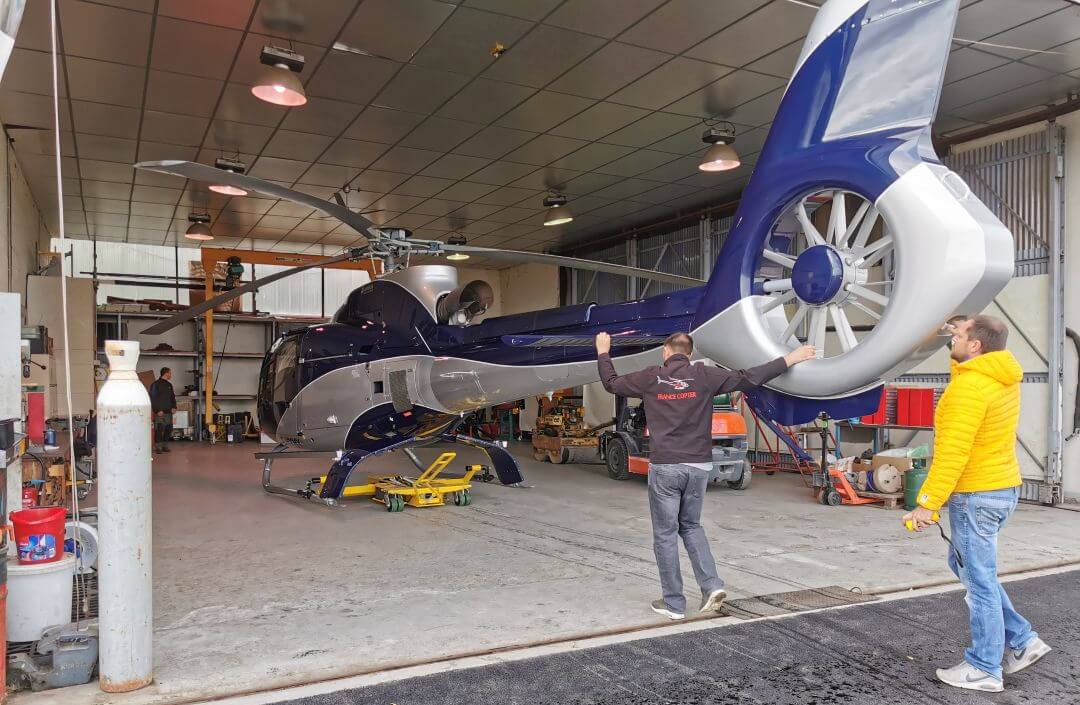
Moving a helicopter in a hangar sounds simple enough. The aircraft is on the ground, the space is familiar, and the destination may only be a few feet away. But any pilot, mechanic, owner, or ground crew member knows the truth: hangar moves are where small mistakes can become expensive very quickly.
Between rotor blade and tail boom clearance, door width, floor slope, storage equipment, lighting, toolboxes, vehicles, and other aircraft, there’s not much room for guesswork. That’s why knowing how to move a helicopter in a hangar safely is essential for protecting your aircraft, your crew, and everything else inside the space.
This guide focuses specifically on helicopter ground handling hangar procedures. For a broader look at designing and organizing the space itself, start with our helicopter hangar checklist.
Why Hangar Moves Require Extra Care
Outside on an open ramp, crews typically have more space to correct movement and reposition the aircraft. Inside a hangar, every inch matters.
Hangar moves often involve:
- Narrow door openings
- Low or irregular ceiling clearance
- Other aircraft parked nearby
- Toolboxes, ladders, carts, and maintenance equipment
- Skid-mounted accessories, cameras, floats, baskets, or other gear
- Limited visibility around the tail and rotor system
- Painted floors or slick surfaces
- Tight turning requirements
This is why helicopter hangar safety should never rely on “we’ve done it before.” Familiar spaces can create false confidence. A safe move requires a clear process every time, whether you’re moving a small private aircraft, a mission-ready HEMS helicopter, or a larger fleet aircraft.
1. Plan the Full Movement Path Before the Helicopter Moves
Before touching the aircraft or connecting ground handling equipment, walk the entire path from start to finish.
That means checking the aircraft’s current position, the intended destination, the turn radius, the doorway, the tail path, and any nearby obstacles. Don’t just look where the skids or wheels will travel. Look at the full footprint of the aircraft.
A safe movement plan should account for:
- Main rotor diameter
- Tail rotor or fenestron clearance
- Tail boom swing
- Skid width
- Door frame clearance
- Ceiling height
- Floor slope or surface changes
- Vehicles, cabinets, lifts, and workstands
- Personnel movement around the aircraft
If you’re wondering how to safely move a helicopter into a hangar, this is the first answer: slow down before the move begins. The safest movement is the one that has already been visualized, communicated, and cleared.
Marking a standard path on the floor can also help. Painted lines, cones, floor tape, or permanent hangar markings give operators and spotters a visual reference, especially when moving a helicopter in a tight hangar space.
2. Confirm Rotor Blade, Tail, and Door Clearance
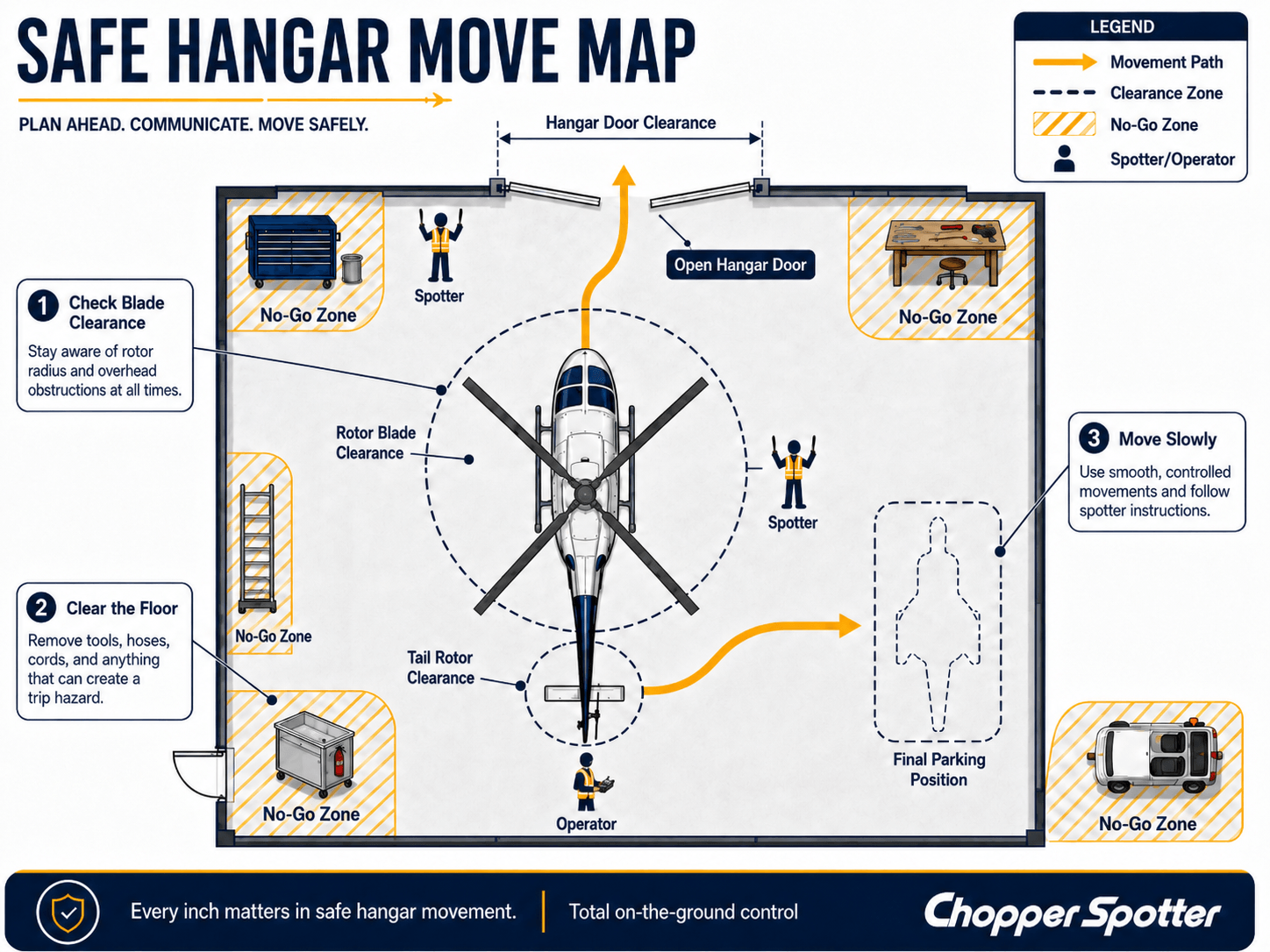
Helicopter rotor blade clearance hangar planning is one of the most important parts of any safe move. Blades extend far beyond the cabin, and even a slow, controlled move can create risk if the aircraft pivots too close to a wall, beam, light fixture, door frame, or parked equipment.
Before the move, check:
- Main rotor blade tip clearance
- Tail rotor clearance
- Tail boom clearance
- Door height and width
- Clearance around lights, signs, beams, heaters, sprinklers, and ceiling fixtures
- Any antennas, cameras, floats, baskets, or accessories mounted to the aircraft
Helicopter hangar door clearance deserves special attention. Many incidents happen not because the aircraft cannot fit through the door, but because the approach angle is slightly off. A few degrees of misalignment can create risk for the blades, tail, skids, or installed equipment.
When possible, approach the hangar door squarely and avoid last-second corrections at the threshold. If the aircraft must angle through the door, use trained spotters and take the move step by step.
3. Clear the Hangar Floor and Control the Work Area
A hangar is a working environment, which means there’s almost always something on the floor that shouldn’t be there during an aircraft move.
Before moving a helicopter in a hangar, clear the path of:
- Toolboxes
- Extension cords
- Maintenance carts
- Fluid containers
- Ladders
- Aircraft parts
- Workstands
- Loose hardware
- Tow bars or unused equipment
- Personal items
Also control who is allowed in the movement area. Passengers, visitors, and non-essential personnel should stay clear until the aircraft is parked, secured, and the move is complete.
For larger operations, assign a lead operator and one or more spotters. For smaller private hangars, even when one person is doing the actual move, it’s still important to pause and verify the path before moving.
Good helicopter tug hangar safety starts with removing surprises. The fewer obstacles and people in the path, the easier it is to maintain full control.
4. Use the Right Ground Handling Equipment
The equipment you use can make the difference between a smooth move and a stressful one.
There are several ways to move helicopters on the ground, including ground-handling wheels, dollies, tow carts, and remote-controlled tugs. Each has a place, depending on the aircraft, landing gear, surface, storage space, and operator preference. Our guide to helicopter ground handling equipment breaks down the main options in more detail.
Use the quick comparison below to match the method to your aircraft, your operators, and your hangar space:
|
Method |
Best for |
Operators needed |
Control in tight spaces |
Hangar-rash risk |
|---|---|---|---|---|
|
Ground-handling wheels |
Small, light skidded helicopters on smooth hangar floors |
Often 2+ (manual push/pull) |
Limited — hard to steer precisely by hand |
Higher — relies on muscle and momentum |
|
Dolly/platform |
Storing a skidded aircraft in a fixed spot |
1–2 with a tow vehicle |
Moderate — fine straight, weaker on tight turns |
Moderate — depends on tow control |
|
Tow cart |
Larger helicopters needing motorized movement |
Often 1 |
Moderate to good |
Moderate — operator walks alongside |
|
Remote-controlled tug (Chopper Spotter) |
Precise, repeatable single-operator moves in tight hangars |
1 |
High — incremental positioning at the skids |
Lower — slow, deliberate, full operator control |
For many skidded helicopters, a purpose-built tug provides the safest, most controlled option for hangar movement. Chopper Spotter’s electric helicopter tugs are built for single-operator ground handling, precise positioning, and tight-space maneuvering. Because the unit connects at the skids and gives the operator controlled movement, it can help reduce the strain and uncertainty that come with pushing, pulling, or balancing aircraft manually.
If you’re comparing different systems, our Chopper Spotter vs. HeliWagon article can also help explain key differences in how these systems operate.
The main takeaway is simple: don’t force the aircraft to fit the equipment. Choose equipment that fits the aircraft, the hangar, and the way your team actually moves.
5. Assign Roles and Communication Before the Move
Even a short hangar move should have a clear communication plan.
Before the aircraft moves, confirm:
- Who is operating the tug or ground-handling equipment
- Who is watching the main rotor area
- Who is watching the tail
- Who is monitoring the door frame
- What signals will be used
- What command means stop immediately
- Where other personnel should stand
Hand signals should be simple, visible, and understood by everyone involved. In noisy environments, verbal communication may not be enough. If radios are used, test them before the move.
Most importantly, anyone should be able to call “stop.” If a spotter sees an issue, the operator should pause immediately and reassess. A few extra seconds are always better than hangar rash, helicopter damage, blade contact, or injury.
6. Move Slowly, Smoothly, and Deliberately
When moving a helicopter inside a hangar, speed is not the goal. Control is.
Use slow, smooth inputs. Avoid sudden starts, stops, or sharp turns. Keep the aircraft centered on the planned path and make small adjustments early rather than large corrections late.
Pay close attention when:
- Crossing the hangar threshold
- Turning near walls or other aircraft
- Moving over floor seams or drainage areas
- Passing vehicles or equipment
- Backing into a final parking position
- Repositioning near maintenance stands
If something doesn’t look right, stop. Recheck the path. Move equipment. Adjust the angle. Ask for another spotter if needed.
The best operators aren’t the ones who move the fastest. They’re the ones who make every move look boring, controlled, and uneventful.
7. Inspect, Secure, and Reset the Space
Once the helicopter is in position, the job isn’t quite finished.
Inspect the aircraft and surrounding area before walking away. Check the skids, tail, rotor clearance, door area, and any installed accessories. Confirm the aircraft is parked exactly where it should be for storage, maintenance, or launch readiness.
Then secure the aircraft according to your procedure. That may include chocks, tie-downs, blade restraints, drip pans, covers, or other equipment depending on your aircraft and operating environment.
Finally, reset the hangar to how it was. Return the tug or ground-handling equipment to its proper location, clear the movement path, plug in chargers if needed, and document any issues from the move.
Safe helicopter hangar operations depend on repetition. When the space is reset after every move, the next move starts with less risk.
Why Chopper Spotter Makes Hangar Movement Safer and Easier
Hangar movement should be controlled, repeatable, and efficient. Chopper Spotter was designed with those priorities in mind.
By supporting single-operator control, stable skid engagement, and precise movement in tight spaces, Chopper Spotter helps owners and operators move helicopters with greater confidence. Whether you’re pulling an aircraft out for a flight, positioning it for maintenance, or storing it safely at the end of the day, the right equipment helps reduce risk and simplify the process.
For private owners, that can mean protecting an aircraft and other valuable equipment in a tight garage or hangar. For fleet operators, it can mean smoother workflows, fewer personnel required for routine moves, and more consistent aircraft positioning.
If you’re ready to improve your helicopter ground handling hangar process, contact Chopper Spotter to talk with our team about the right model for your aircraft, hangar layout, and operating environment.
Because safe helicopter movement doesn’t happen by accident. It happens with the right process, the right equipment, and total on-the-ground control.
Frequently Asked Questions About Moving a Helicopter in a Hangar
How do you safely move a helicopter in and out of a hangar?
To safely move a helicopter in and out of a hangar, plan the full movement path first, confirm rotor and tail clearance, clear obstacles, assign communication roles, use proper ground-handling equipment, and move slowly with full control. The safest moves are planned before the aircraft ever starts moving.
What is hangar rash and how common is it?
Hangar rash is a general term for aircraft damage that occurs during storage, maintenance, or ground handling. It can include scratches, dents, blade contact, tail damage, skid damage, or damage from tools and equipment. It’s common enough in aviation that operators use the term widely, which is why careful movement procedures matter.
Can one person move a helicopter safely in a hangar?
Yes, one trained person can move many helicopters safely in a hangar when using the right equipment and following the proper procedure. However, depending on hangar layout, aircraft size, visibility, and clearance, additional spotters may still be helpful or required by your organization’s safety process.
What’s the biggest risk when moving a helicopter inside a hangar?
The biggest risk is usually contact with something around the aircraft, such as a wall, door frame, ceiling fixture, tool cart, vehicle, another aircraft, or hangar equipment. Rotor blade, tail boom, tail rotor, skid, and accessory clearance should all be checked before and during the move.
How much clearance does a helicopter need to enter a hangar safely?
Clearance depends on the aircraft, rotor diameter, tail configuration, skid width, door dimensions, installed equipment, and the angle of entry. Operators should follow manufacturer guidance, measure the hangar opening, and allow enough margin for safe movement rather than relying on a “just fits” approach.
Should you use ground-handling wheels, a dolly, or a tug to move a helicopter in a hangar?
It depends on your helicopter and hangar environment. Ground-handling wheels may work for some smaller skidded helicopters, dollies may be useful for certain storage setups, and tugs are often ideal for controlled movement in tight spaces. A purpose-built helicopter tug can offer better control, safer positioning, and less manual strain for many hangar operations.
What should you check before moving a helicopter in a hangar?
Before moving a helicopter, check the route, door clearance, rotor blade clearance, tail clearance, floor surface, obstacles, aircraft accessories, personnel locations, ground-handling equipment condition, battery charge, communication signals, and final parking position. If anything is unclear, pause and correct it before starting the move.