Fast Turnarounds Without Dollies: Queueing and Staging Patterns
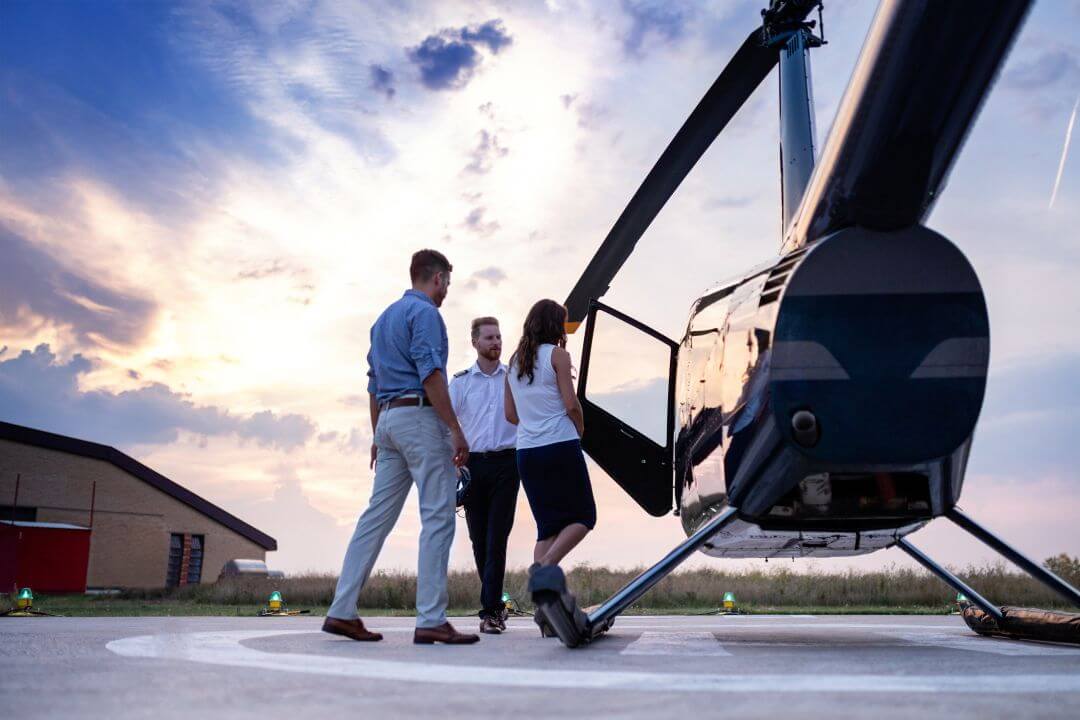
A great helicopter sightseeing experience depends on more than the flight itself. It starts before passengers board and continues through every arrival, departure, safety briefing, aircraft repositioning, and ramp handoff.
When your operation is managing steady passenger flow, multiple departures, tight landing areas, changing weather, and high expectations, the ground process has to be just as dialed in as the flight plan.
That’s where smart helicopter operations staging comes in.
With the right staging patterns, parking layout, hand-signal systems, and ground handling equipment, tour operators can reduce congestion, improve safety, and keep flights moving efficiently—without relying on dollies or overly complicated towing workflows.
For busy helicopter tourism companies, that can mean faster turnarounds, smoother passenger movement, and more predictable daily operations.
Why Ground Staging Matters in Helicopter Tourism
Helicopter tours are built around timing. Passengers arrive for a scheduled experience, aircraft rotate through back-to-back flights, pilots need safe and efficient transitions, and ground crews are responsible for keeping people, equipment, and aircraft moving in the right direction.
If the ramp becomes disorganized, delays can stack up quickly. A late departure can affect the next group of passengers. A helicopter parked in the wrong place can slow fueling or boarding. A poorly defined movement path can increase risk near people, vehicles, and other aircraft.
That’s why ramp operations for helicopter tours should be built around a clear, repeatable system.
Strong helicopter operations staging helps operators:
- Keep passenger flow separate from aircraft movement
- Reduce unnecessary repositioning
- Improve visibility for pilots and ground crew
- Maintain consistent boarding and unloading zones
- Protect aircraft from preventable ground handling incidents
- Support faster helicopter tour ground handling turnaround times
In tourism, smoother ground operations do more than save time. They create a better guest experience.
When passengers see a calm, organized ramp, it builds confidence. When crews know exactly where each aircraft belongs, they move with purpose. When aircraft can be positioned safely by a single operator, the entire operation becomes more efficient.
The Problem With Dollies in High-Traffic Tour Operations
Dollies have their place in some helicopter storage and maintenance environments, but they can create challenges for fast-paced tourism operations.
Traditional dolly systems often require additional setup, careful alignment, and extra movement steps. They may also take up valuable ramp or hangar space when not in use. In a busy tour environment where aircraft are moving in and out frequently, every extra step adds time and complexity.
Our guide to the three different types of helicopter ground handling equipment is a helpful resource that explains how different tools support different use cases and why the right solution depends on your aircraft, space, staffing, and operational rhythm.
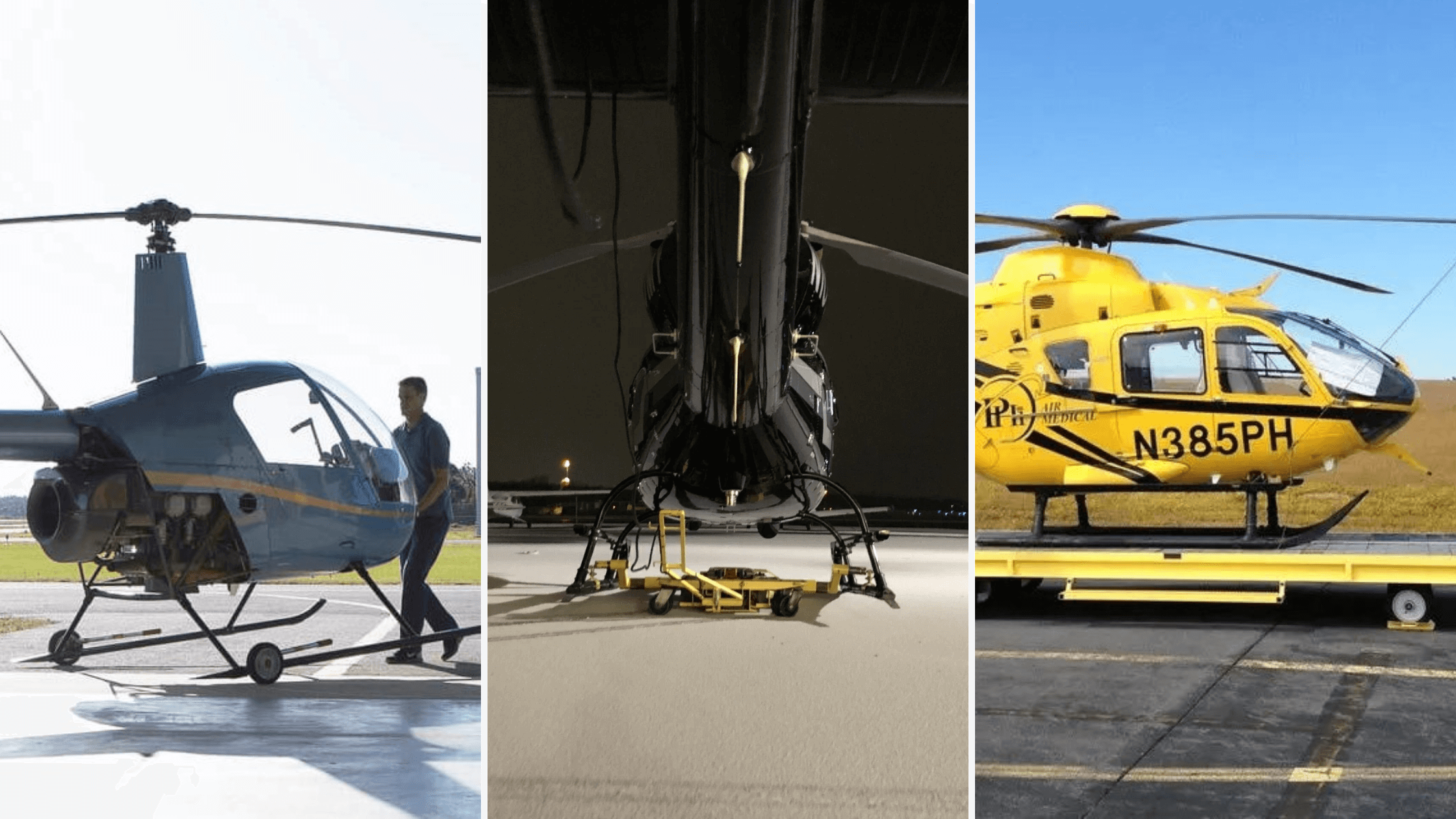
Helicopter tour operators should ask one simple question: Does your current ground handling system help you move faster and safer, or does it create another bottleneck?
For many high-volume sightseeing companies, a compact, single-operator helicopter mover can simplify the process. Instead of coordinating multiple people around a dolly or relying on a larger tug in a tight space, the right equipment can help one trained operator reposition the aircraft with precision and control.
Passenger Safety and Perception
Tourism operations are unique because customers are often nearby, excited, distracted, and unfamiliar with aviation environments.
That makes ground safety especially important.
A well-organized staging pattern can help keep passengers away from aircraft movement zones. Clear boundaries, visible staff, pre-boarding instructions, and controlled walking routes all contribute to a safer and more professional experience.
It also improves perception. Guests may not understand the technical details of helicopter tour ground handling turnaround, but they can recognize when an operation feels organized. Smooth aircraft positioning, confident crew movement, and clean staging areas all help reinforce trust.
For premium and private charter experiences, this matters even more. Customers expect efficiency, comfort, and professionalism from arrival to departure.
Chopper Spotter’s helicopter ground transport solutions are built around that same expectation: Aircraft movement should be safe, controlled, efficient, and aligned with the quality of the overall experience.
Building a Better Staging Pattern for Tour Helicopters
A staging pattern tour helicopter operators can use successfully should be simple, visible, and repeatable.
The goal is to make every aircraft movement predictable. Pilots, ground handlers, fuelers, photographers, maintenance teams, and passenger service staff should all understand where aircraft enter, where they wait, where passengers board, and where aircraft depart.
Here are several staging patterns that can support faster, safer tour operations.
1. The Straight-Line Queue
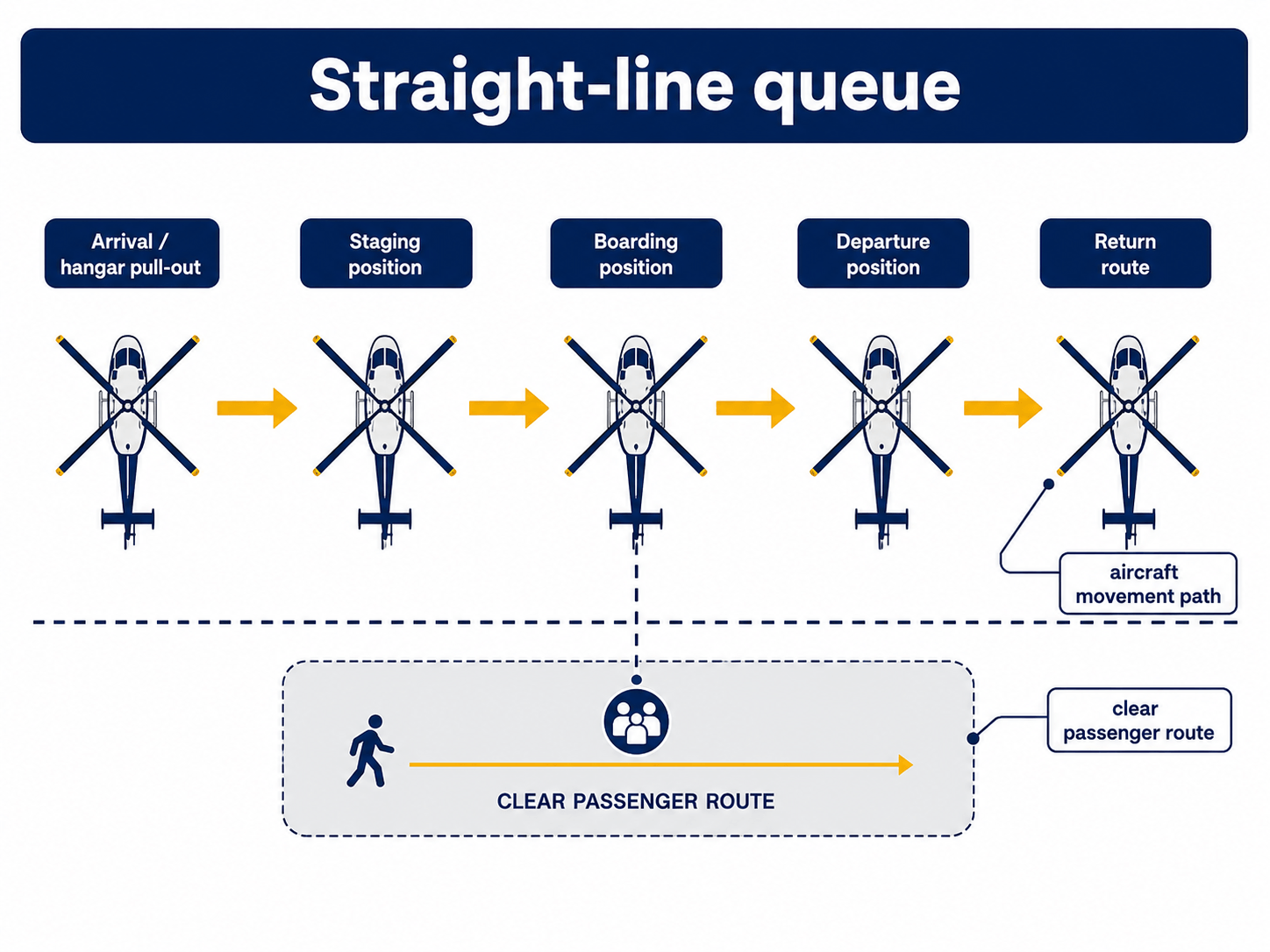
The straight-line queue works well when a tour base has a defined ramp lane or apron area with clear entry and exit points. Aircraft move through the same basic sequence:
- Arrival or hangar pull-out
- Staging position
- Boarding position
- Departure position
- Return route after landing
This layout is easy to understand and simple to train. It helps ground crews keep aircraft aligned and reduces crossing paths between passengers, vehicles, and rotorcraft.
For helicopter tour ground handling turnaround, the straight-line queue can be especially helpful when operators run frequent departures of the same tour length. Each aircraft moves forward through the process like a controlled production line, but with aviation safety and passenger comfort at the center.
The key is maintaining enough spacing between aircraft and creating clear “no-go” areas for passengers. Painted ramp markings, cones, signage, and consistent hand signals can all help reinforce the pattern.
2. The Hub-and-Spoke Staging Pattern
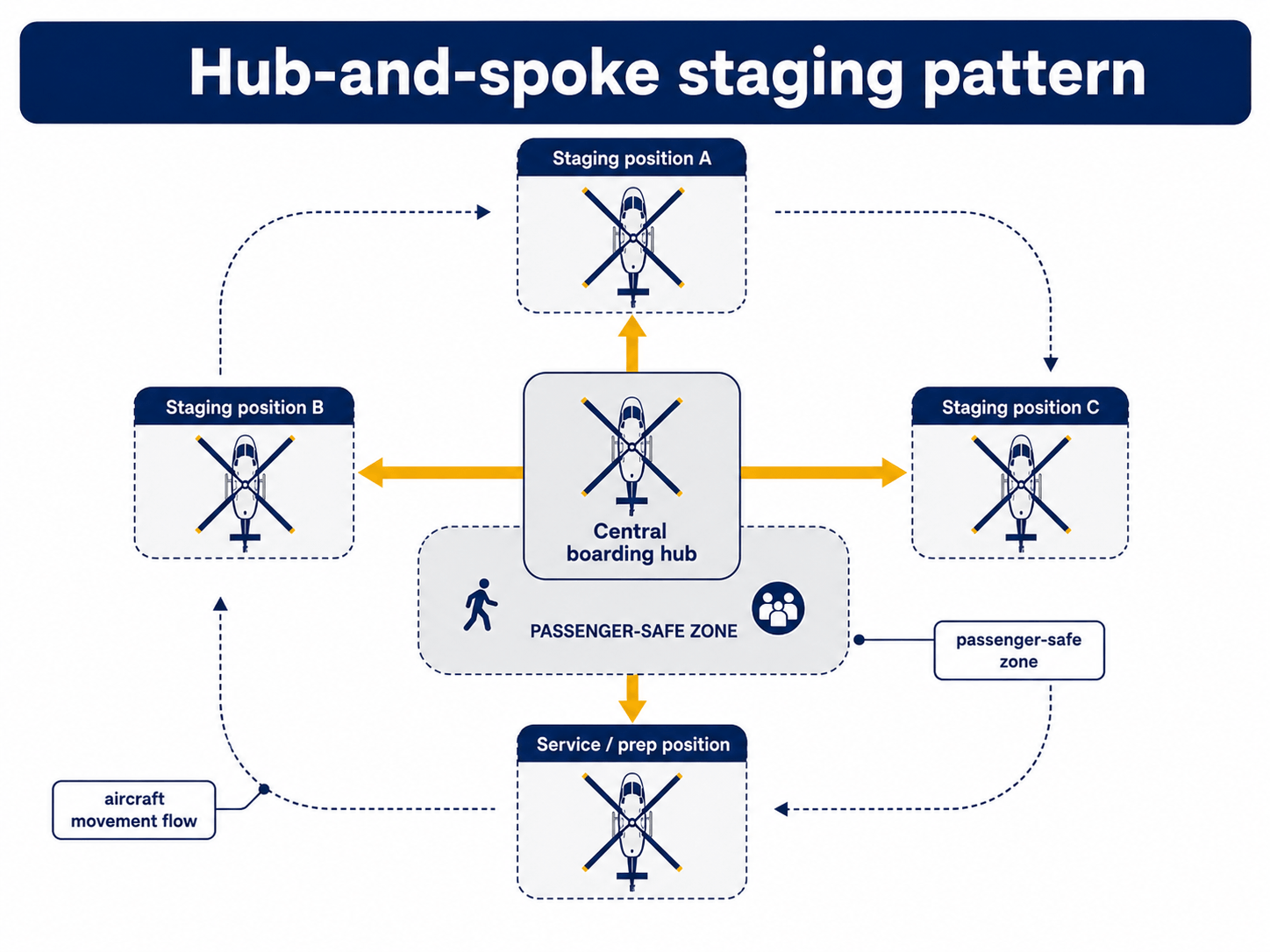
For tour companies operating multiple helicopters from one central facility, a hub-and-spoke pattern may work better.
In this layout, the primary boarding area acts as the hub, while aircraft are staged in nearby spoke positions. When an aircraft is ready for passengers, it is moved or guided into the active boarding position. After passengers load and safety checks are complete, it transitions to the departure path.
This approach can help operators manage multiple aircraft without crowding the main passenger zone. It also allows crews to keep one aircraft actively loading while another is being prepared, cleaned, fueled, or repositioned.
A Chopper Spotter can support this type of helicopter operations staging by making it easier to move aircraft precisely between hangar, staging, and launch positions. The ability to control movement with a compact system is especially helpful when aircraft need to be positioned around other aircraft, service vehicles, or passenger areas.
3. The Ready-Reserve Pattern
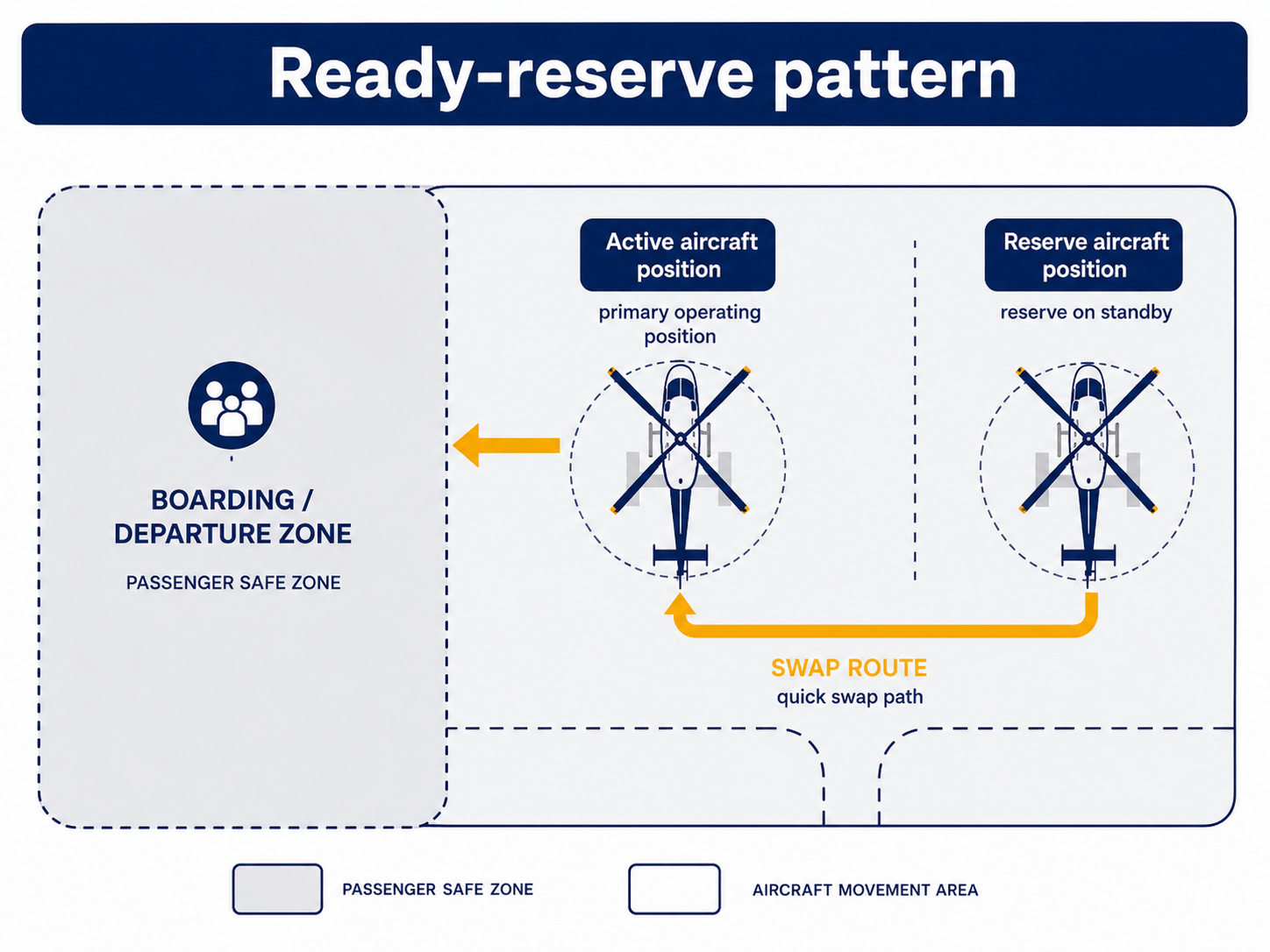
Some tourism operators maintain one primary aircraft in active use and a secondary aircraft in ready-reserve status. This is common when weather, maintenance, passenger demand, or scheduling variability requires flexibility.
In a ready-reserve staging pattern, the active aircraft remains closest to the boarding and departure path. The reserve aircraft is positioned nearby but outside the main passenger movement zone. If the active aircraft needs to be swapped, the reserve can be moved quickly into position.
This can reduce disruption and help protect revenue when a schedule is full. Rather than pausing operations while crews reorganize the ramp, the reserve aircraft is already staged for a fast transition.
For tourism companies serving high-demand destinations, this type of planning can be valuable. Whether you are operating scenic flights over mountains, coastlines, canyons, cities, islands, or glaciers, passengers expect the experience to feel smooth and professional.
4. The Hangar-to-Ramp Shuttle
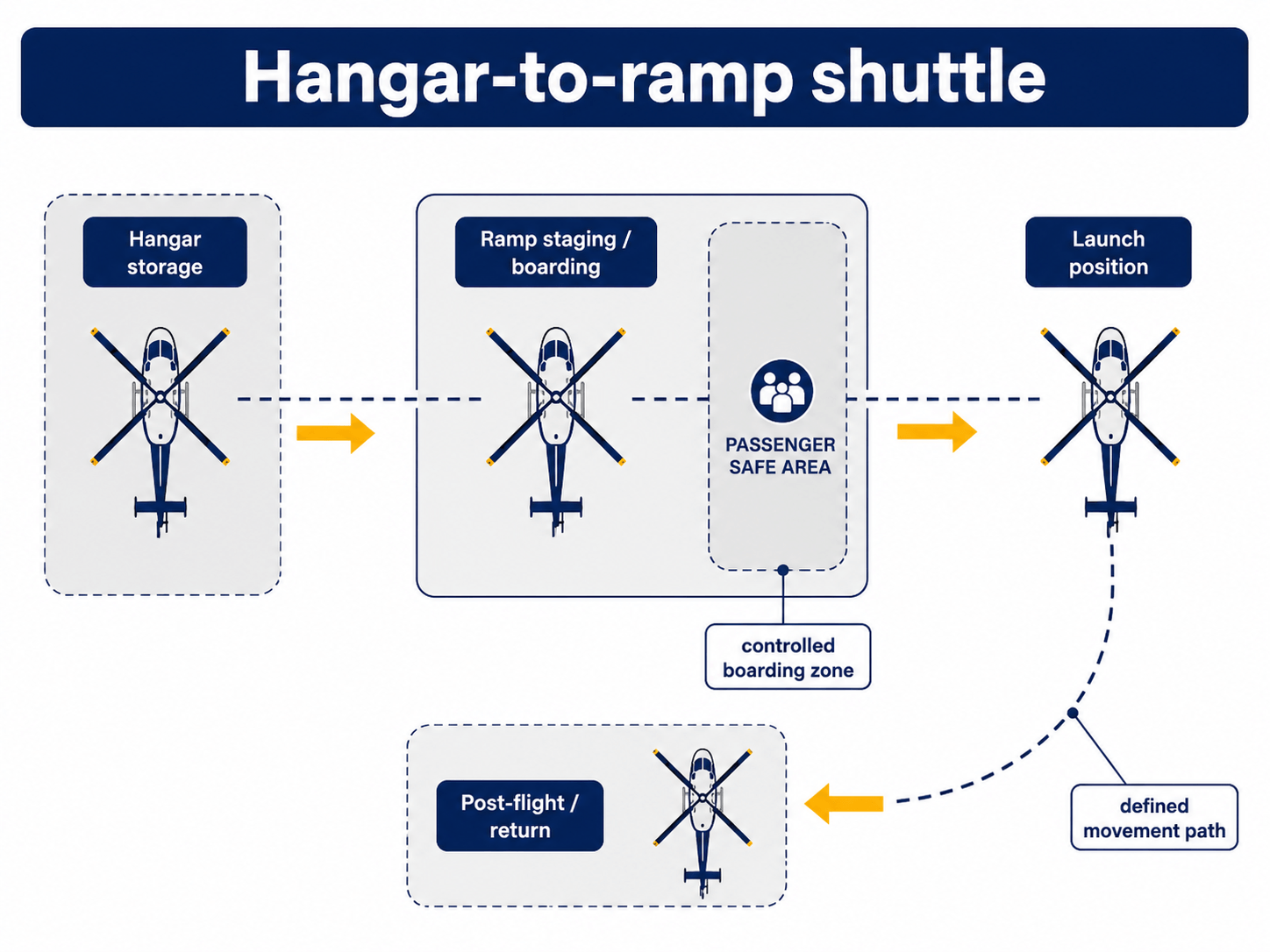
For operators with limited ramp space, aircraft may need to remain inside a hangar until shortly before departure. In this case, the ground handling system becomes central to the schedule.
A hangar-to-ramp shuttle pattern creates a defined movement process between storage and launch areas. The aircraft is pulled from the hangar, positioned for boarding or staging, and then returned after the flight or moved into a post-flight area.
This pattern requires a clean hangar layout, clear communication, and reliable ground support equipment. Our guide on five tips for safely moving a helicopter on the ground is a good resource for reinforcing best practices around situational awareness, controlled movement, surface conditions, and trained personnel.
Hand-Signal Systems for Safer Ramp Coordination
Equipment matters, but communication matters just as much.
Every helicopter tour operator should have a clear hand-signal system for ramp movement, especially when noise, rotor wash, headsets, passenger activity, and distance make verbal communication unreliable.
A good system should define signals for:
- Stop
- Move forward
- Move backward
- Slow down
- Turn left
- Turn right
- Hold position
- Lower or set the aircraft
- Disconnect equipment
- Clear to proceed
- Emergency stop
The most important part is consistency. Everyone involved in ramp operations for helicopter tours should use the same signals every time. That includes pilots, ground handlers, maintenance staff, fuelers, and seasonal employees.
Training should also cover who has authority during each phase of movement. For example, one designated ground handler may direct aircraft positioning while another monitors passenger boundaries or tail clearance. Even if a Chopper Spotter allows one operator to move the aircraft, additional personnel may still be assigned to safety monitoring depending on the layout, aircraft type, and operating environment.
The best operations do not leave that up to chance.
Choosing Equipment That Supports the Pattern
Not every helicopter mover is right for a tour operation. The best choice depends on your aircraft type, surface conditions, available space, staffing, and how often aircraft are moved throughout the day.
When evaluating ground support equipment, tour operators should look for:
- Single-operator control
- Compatibility with current aircraft
- Easy movement in tight staging areas
- Compact storage
- Durable construction
- Smooth and precise positioning
- Low maintenance requirements
- Support from a knowledgeable manufacturer
Our guide on what to look for in a helicopter transport offers a helpful overview for operators comparing options.
Faster Turnarounds, Better Tours
Tour operators compete on experience, safety, reliability, and schedule performance. The view may be what passengers remember most, but the ground operation is what makes the flight possible.
By improving helicopter operations staging, refining queueing patterns, training consistent hand signals, and choosing the right ground handling equipment, tourism companies can reduce delays and make better use of each aircraft.
That can support:
- More predictable departure times
- Smoother passenger flow
- Better use of ramp and hangar space
- Fewer unnecessary aircraft movements
- Improved safety around people and equipment
- More efficient helicopter tour ground handling turnaround
- Stronger revenue potential during peak tourism seasons
Fast turnarounds should never come at the expense of safety. With the right system, operators can support both.
Make Every Turnaround Count With Chopper Spotter
Whether your company operates scenic flights, private tours, resort transfers, adventure excursions, heli-skiing access, or high-volume sightseeing routes, Chopper Spotter can help simplify the way your team moves aircraft on the ground.
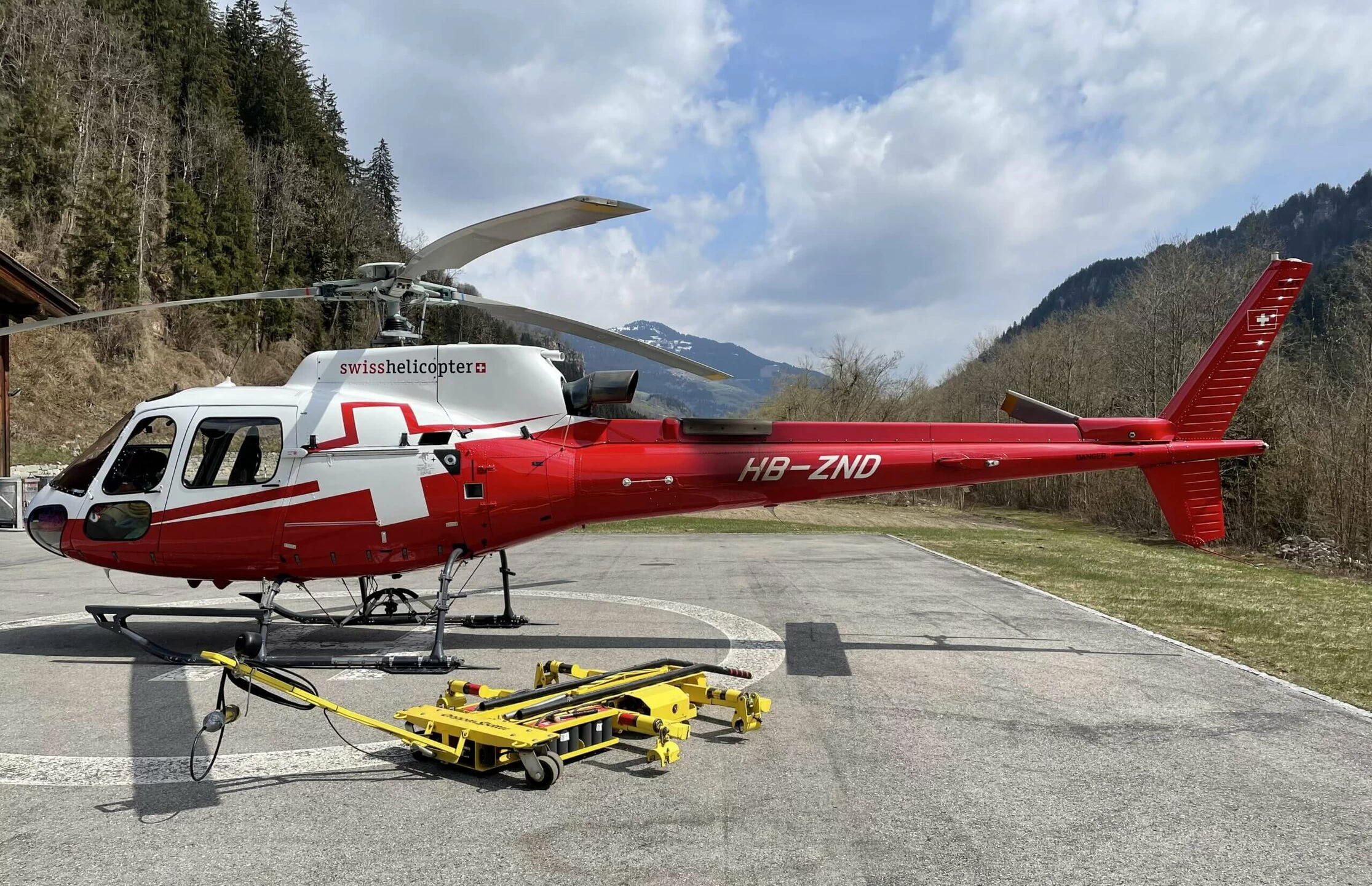
Our helicopter ground handling systems are built for safe, precise, single-operator control, helping tour operators position aircraft efficiently in tight hangars, busy ramps, and high-traffic staging areas.
If your team is ready to reduce ground handling complexity, improve staging flow, and keep more tours moving on schedule, Chopper Spotter is ready to help.
Explore our solutions for luxury and tourism helicopter operations or request a quote today to find the right system for your aircraft and operation.
Because every great helicopter tour starts with a smooth move on the ground.