Helicopter Noise Abatement Protocols: How to Balance a VIP Experience With Government Regulations

For VIP helicopter charter companies, the passenger experience begins long before the helicopter arrival.
It begins with the booking process, the ground transfer, the timing, the crew’s professionalism, the boarding environment, and the way the aircraft is presented. For clients paying for private, premium air transport, everything should feel smooth, discreet, and highly controlled.
But in major cities, luxury helicopter operations must also account for something passengers may not think about until they hear it: the noise.
Aircraft noise abatement isn’t just a regulatory topic. It’s a customer experience topic, a community relations topic, and a long-term business sustainability topic. The best VIP charter operators know how to balance passenger expectations with noise abatement practices, local helicopter noise regulations, and the realities of operating near dense urban areas.
The goal isn’t to make helicopters silent. That’s obviously not realistic. The goal is to build professional, repeatable protocols that reduce avoidable noise, respect surrounding communities, support compliance, and still deliver the elevated experience VIP clients expect.
Why Noise Abatement Matters for VIP Helicopter Charter Operators
VIP helicopter charters often operate in some of the world’s most demanding environments: financial districts, private terminals, resort corridors, airport transfer routes, waterfront heliports, major event venues, and high-value urban centers.
These locations come with ample opportunity, but they also come with added scrutiny.
A single helicopter arrival may be routine for your team, but to residents, businesses, hotels, government officials, and venue managers nearby, noise can feel disruptive if it’s too frequent, unexpected, or poorly managed. Over time, repeated complaints can lead to tighter helicopter noise regulations, operating restrictions, route limitations, curfews, or reputational concerns.
That’s why helicopter charter noise abatement should be treated as part of your professional operations, not as an afterthought.
A strong noise abatement protocol can help operators:
- Reduce avoidable noise during arrivals and departures
- Maintain better relationships with airports, heliports, and communities
- Improve passenger comfort during ground transitions
- Support compliance with local operating requirements
- Build trust with corporate, government, and private clients
- Protect long-term access to valuable urban routes and landing sites
For charter operators serving executive travelers, luxury guests, government delegations, celebrities, medical executives, event clients, or private aircraft owners, professionalism matters. Noise discipline is a big part of that professionalism.
Start With Local Helicopter Noise Regulations, Not Assumptions
Helicopter noise abatement practices vary widely by city, state, airport, heliport, and country. A procedure that’s acceptable at one location may not be appropriate at another.
Before building or updating your internal protocol, always review the requirements that apply to your operating area. These may include:
- Airport or heliport noise procedures
- Preferred arrival and departure routes
- Altitude or approach path guidance
- Curfew or quiet-hour rules
- Restrictions for specific neighborhoods or landmarks
- Event-based temporary procedures
- Local reporting or complaint response processes
- Manufacturer or aircraft-specific operating recommendations
For instance, HAI/VAI “Fly Neighborly” Program and FAA Advisory Circular 91-36 are both recognized helicopter noise-abatement standards worth reviewing.
For international VIP charter operations, this is especially important. A company flying in New York, London, Paris, Dubai, Sydney, São Paulo, or Monaco may face very different expectations around routing, hours, aircraft type, and community engagement.
The best practice is simple: document the rules for each frequent location, train your team on them, and review them regularly.
Design a Quieter Helicopter Arrival Experience
A VIP helicopter arrival should feel calm, controlled, and intentional.
That doesn’t mean removing the excitement of the helicopter. It means reducing unnecessary disruption around the arrival process.
From a guest perspective, the moment of arrival is part of the overall experience. Clients may be stepping onto a private ramp, arriving at a luxury property, connecting from a jet, or transferring to a major event. They expect confidence and coordination.

From an operations perspective, the helicopter arrival should also follow a clear pattern:
- Confirm route, landing site, and any local noise abatement procedures.
- Coordinate with ground staff before the aircraft reaches the site.
- Keep vehicles, passengers, and equipment clear of the operating area.
- Use a defined staging pattern for unloading and repositioning.
- Minimize unnecessary ground running where possible.
- Move the aircraft efficiently once passengers are clear.
- Reset the area for the next movement.
Use Ground Handling to Reduce Unnecessary Runtime
Noise abatement is often discussed in terms of flight paths, altitude, approach profiles, and aircraft selection. Those things matter, but ground operations matter too.
If an aircraft has to remain running longer than necessary because it cannot be moved efficiently, the noise impact increases. If ground crews need extra time to position equipment, clear the ramp, or maneuver the helicopter into place, the passenger experience can suffer as well.
A compact, precise helicopter mover helps reduce that friction.
Instead of relying on several people to reposition an aircraft manually or using larger equipment that may be less practical in tight spaces, a Chopper Spotter helps crews move their helicopters with precision and control. SKYbrary lists towing helicopters instead of using engines to taxi and avoiding unnecessary APU/ground running as recognized noise-abatement measures.
For charter companies, this supports two goals at once:
- Better ramp efficiency
- A more refined arrival and departure experience
For companies that want to upgrade the way they move aircraft in premium environments, Chopper Spotter’s charter helicopter ground transport solutions are built for safe, efficient, professional ground handling.
Align Fleet Maintenance With Noise Performance
A well-maintained helicopter is essential for safety, reliability, and passenger confidence. It can also support a more professional sound profile.
Unusual vibration, rough operation, preventable mechanical issues, or inconsistent performance can affect how an aircraft is perceived by passengers and by people near the landing area. VIP clients may not know the technical cause of a rough arrival or unexpected sound, but they can feel when something seems less refined.
That’s why fleet maintenance should be part of your helicopter noise abatement conversation.
Routine inspections, maintenance planning, component care, and accurate records help operators keep aircraft performing as intended. For a deeper look at building strong maintenance habits, see our guide to maintaining a helicopter fleet.
Just as important, your facility layout should support efficient maintenance access. If crews can move aircraft easily into inspection or service positions, they can work more safely and efficiently. Our helicopter hangar checklist can help operators evaluate lighting, access, equipment placement, aircraft movement paths, and overall hangar readiness.
Choose Helicopters and Equipment With the Client Experience in Mind
Many VIP charter operators already prioritize aircraft comfort, cabin finish, seating configuration, performance, range, and onboard technology. Those features matter, especially for executive and luxury travelers.
Helicopter selection can also influence the overall experience around noise, comfort, and perception. Our article on the top luxury helicopters highlights how premium aircraft are often evaluated not only for performance, but also for comfort, design, and passenger experience.
Still, even the finest helicopter can deliver a poor first impression if the ground operation feels chaotic.
Ground support equipment should match the level of service your passengers expect. A VIP client should not arrive to see a rushed, cluttered, or uncertain ramp process. They should see a team that is prepared, controlled, and confident.
That means:
- Aircraft positioned cleanly before passengers arrive
- Ground crew roles clearly assigned
- Passenger paths separated from aircraft movement
- Equipment staged out of the way
- Helicopter movement handled with precision
- Turnarounds completed without unnecessary commotion
The aircraft may get the attention, but the ground process sets the tone.
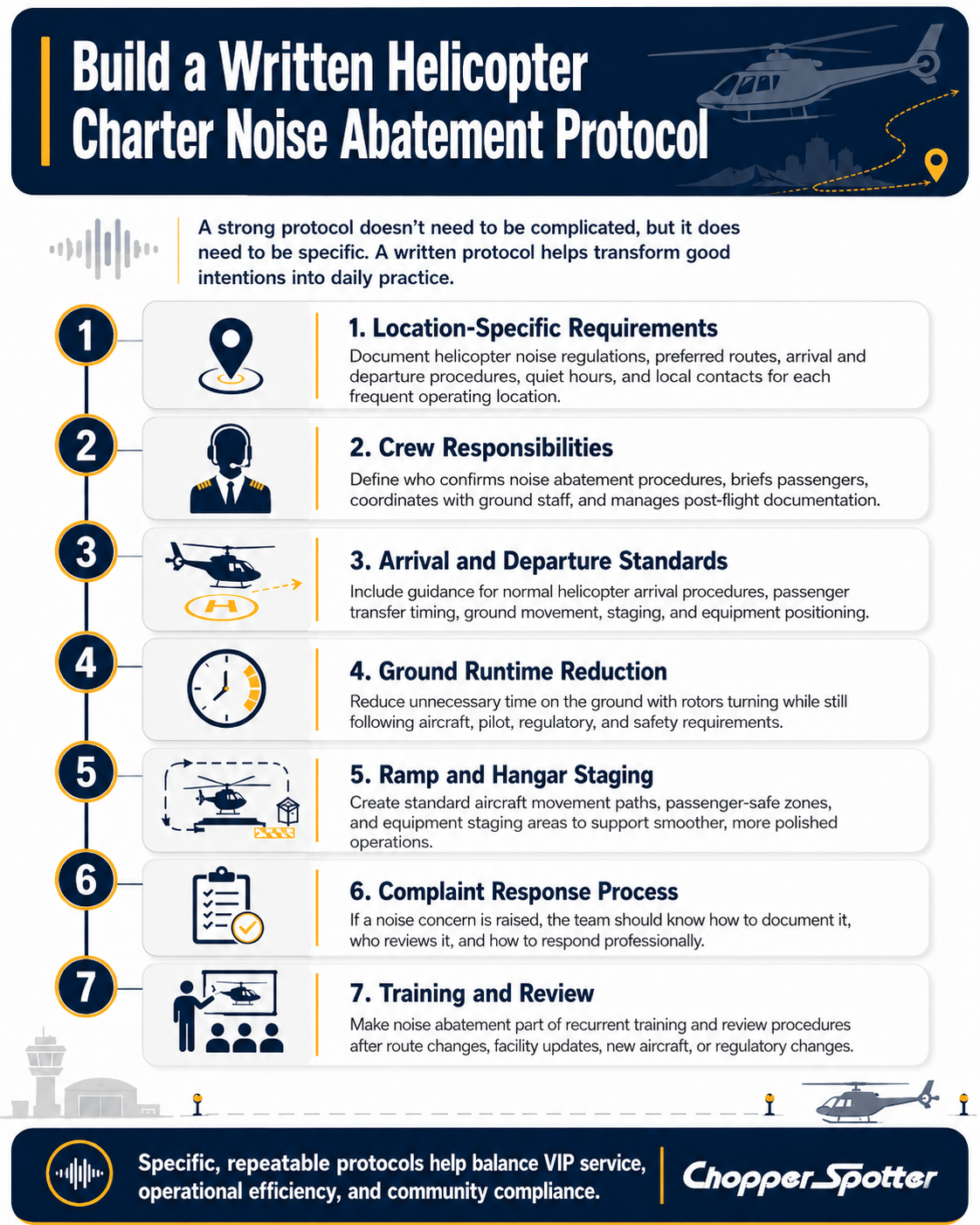
Make Every Arrival Feel More Professional With Chopper Spotter
Aircraft noise abatement isn’t just about reducing sound. It’s about running a more thoughtful, disciplined, and polished operation.
From the way the helicopter approaches the landing site to the way it’s positioned after passenger drop-off, every step contributes to the overall impression of your brand.
Chopper Spotter helps VIP charter operators improve that experience on the ground with safe, precise, single-operator helicopter movement. Whether your team is managing a private hangar, luxury charter facility, FBO ramp, urban heliport, or resort transfer operation, the right ground handling equipment can help reduce friction, improve control, and support a more professional workflow.
Explore our charter helicopter ground transport solutions or request a quote today to find the right model for your fleet.