7 Tips for Helicopter Hangar Space Optimization
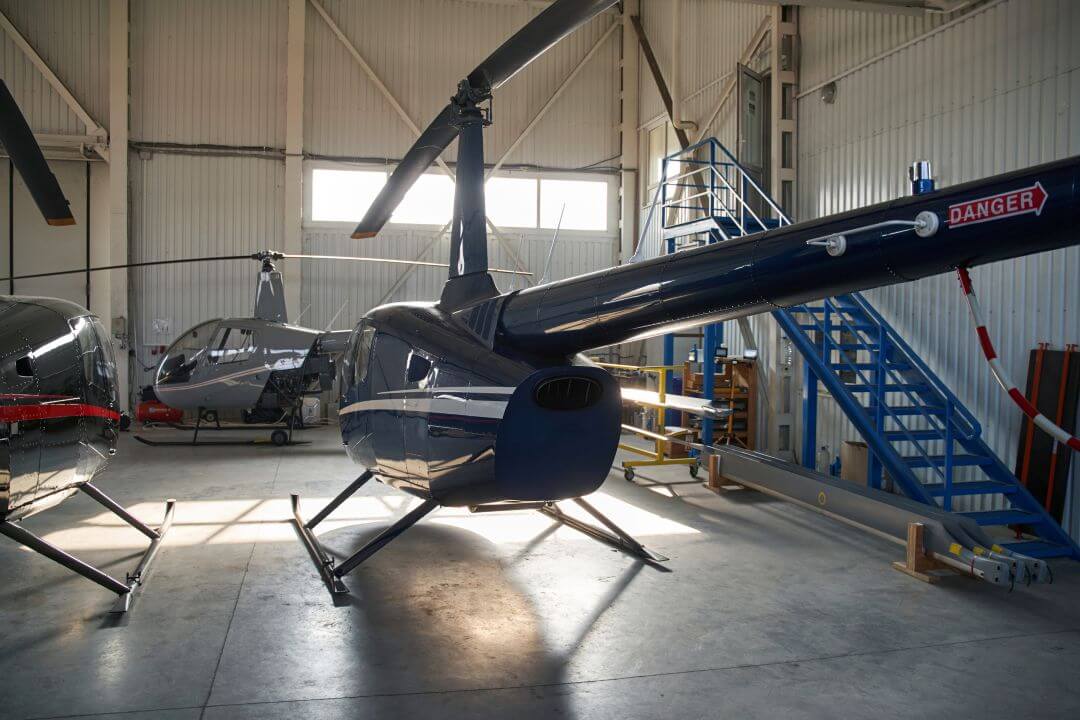
Hangar space has a funny way of disappearing.
A building can look enormous when it’s empty, but add a helicopter, a tug, maintenance equipment, tool storage, work areas, and maybe another aircraft or two, and suddenly every square foot matters.
For owners and operators trying to maximize helicopter hangar space, the answer isn’t simply finding a bigger building. It’s understanding how much of the space you already have is truly usable.
That’s where helicopter hangar space optimization comes in.
Unlike our broader helicopter hangar checklist, which covers everything from lighting and power to security and maintenance equipment, this guide focuses specifically on capacity: aircraft footprints, clearance zones, parking geometry, movement paths, and smarter ways to fit more into the same building.
Whether you’re planning a small helicopter hangar design or managing multi-helicopter hangar storage, these seven tips can help you make every square foot work harder.
1. Measure A Hangar’s Usable Space, Not Just Total Square Footage
A 10,000-square-foot hangar doesn’t give you 10,000 square feet of aircraft parking.
Columns, door tracks, electrical panels, fire equipment, workbenches, storage racks, maintenance zones, walkways, and required access areas all reduce the floor space you can actually use.
Start by creating a scaled helicopter hangar layout that identifies:
- Interior wall dimensions
- Hangar door width and height
- Columns and structural supports
- Permanent equipment
- Emergency exits and access paths
- Maintenance areas
- Tool and parts storage
- Aircraft movement lanes
Think of this as your net usable hangar area rather than your gross building area.
A simple planning calculation is:
Usable hangar area = total floor area – permanent obstructions – required operational zones
That number gives you a much better starting point for helicopter storage space saving than the dimensions printed on a building plan.
2. Calculate the Helicopter’s Full Storage Envelope
One of the most common mistakes in helicopter hangar space optimization is treating the fuselage as the aircraft’s footprint.
Trust us, the rotor system usually tells a different story.
When determining a helicopter hangar footprint, account for:
- Main rotor diameter
- Overall aircraft length
- Tail rotor or fenestron
- Skid width
- Cameras, baskets, floats, or other installed equipment
- Required clearance around the aircraft
For most planning purposes, the safest approach is to create a scaled top-down outline of the complete aircraft and then add your required clearance buffer around it.
Pay particular attention to helicopter rotor diameter hangar clearance. Your layout shouldn’t depend on someone parking the rotor blades in one convenient orientation every time. Unless an approved procedure specifically allows otherwise, plan around the complete rotor arc.
A conservative conceptual formula is:
Planning envelope = full aircraft footprint + required clearance on all sides
Always use your aircraft manufacturer’s dimensions and the clearance requirements applicable to your facility rather than relying on a universal number.
3. Separate Storage Space From Working Space
An aircraft may physically fit somewhere without that space being practical for everyday operations.
A helicopter parked for long-term storage might need a relatively compact envelope. The same helicopter undergoing maintenance may need room for technicians, ladders, carts, panels, parts, and service equipment.
That means your helicopter hangar layout should distinguish between:
- Storage zones: Optimized for safely parking aircraft close together.
- Maintenance zones: Allow additional clearance for technicians and equipment.
- Movement zones: Keep clear paths between aircraft, doors, and work areas.
This distinction becomes particularly important for fleet operators. If every parking position is sized like a full maintenance bay, you may waste valuable capacity. If every position is packed like long-term storage, technicians may constantly reposition aircraft just to perform routine work.
Your maintenance schedule should influence the layout, too. Our guide to maintaining a helicopter fleet covers additional ways to keep service workflows organized.
4. Think in Rotor Arcs, Not Parking Rectangles
Multi-helicopter hangar storage can become a geometry problem very quickly.
Simply drawing equal rectangles side by side often leaves usable space on the table because helicopters aren’t rectangles. Rotor discs, narrow fuselages, and long tail booms create opportunities for smarter positioning.
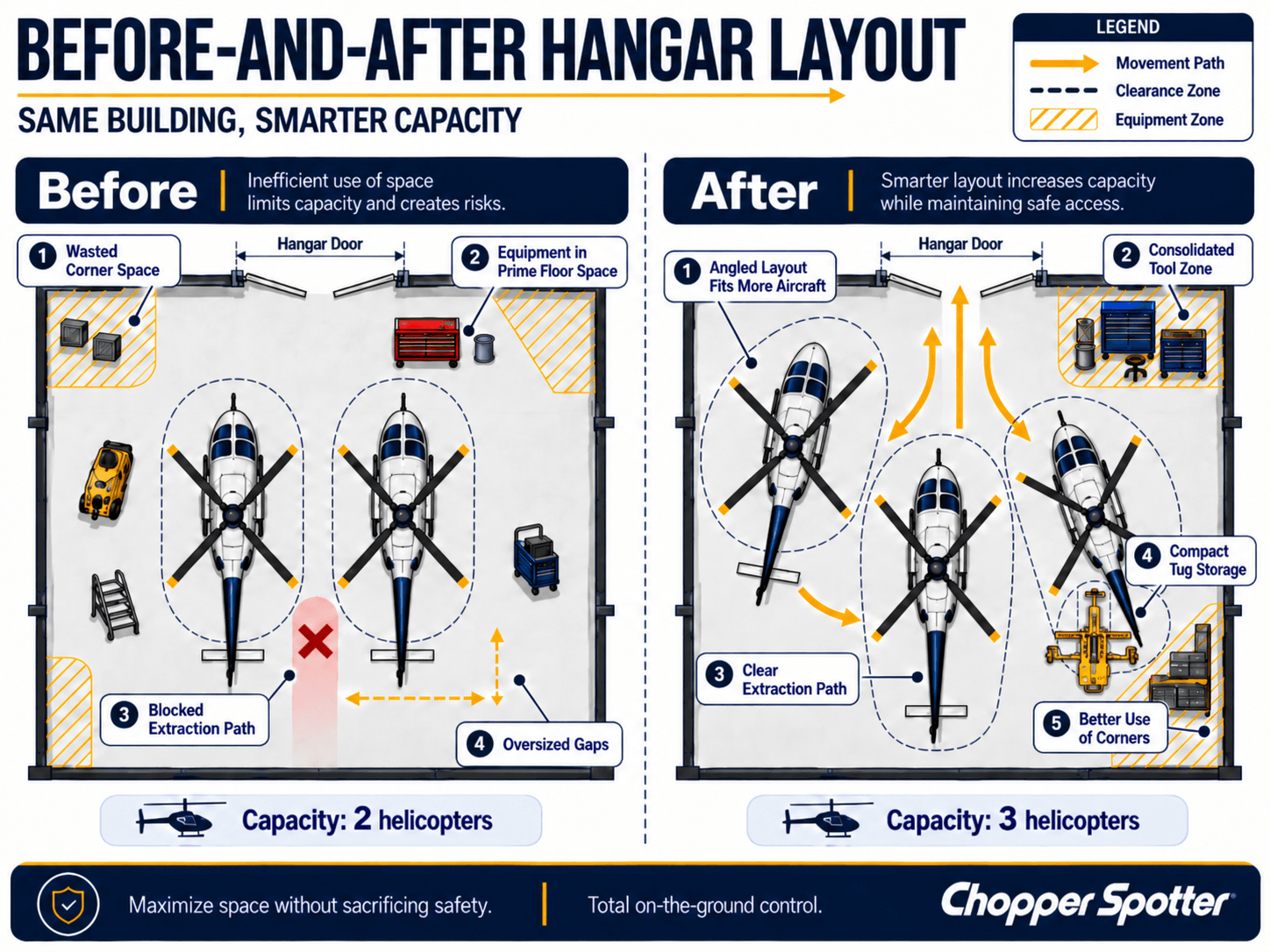
Depending on your aircraft mix and approved clearance requirements, an angled or staggered helicopter hangar layout may use space more efficiently than placing every aircraft perfectly parallel.
For example, operators may be able to:
- Stagger aircraft positions
- Alternate nose and tail directions
- Angle aircraft relative to the hangar wall
- Use irregular corners for tail sections rather than rotor discs
- Position smaller aircraft around the envelopes of larger aircraft
The key is that clearance zones still matter. Don’t “gain” capacity by planning around one specific rotor blade position or by creating a setup that requires inches of perfect positioning every time.
Think of it as hangar Tetris, only with significantly more expensive pieces.
5. Optimize for Extraction, Not Just Maximum Aircraft Count
Fitting six helicopters into a hangar isn’t particularly useful if you have to move five of them every time aircraft No. 6 needs to fly.
A good layout balances capacity with accessibility.
For multi-helicopter operations, organize aircraft based on how frequently they need to move. Helicopters flying daily should generally have simpler access to the door, while aircraft in extended maintenance or longer-term storage can occupy less accessible positions.
Ask questions such as:
- Which aircraft launches most frequently?
- Which helicopter is most likely to move first?
- How many other aircraft must move to reach it?
- Is there a clear path from each parking position to the door?
- Can aircraft be repositioned without creating a bottleneck?
A useful metric is moves per extraction. If getting one helicopter out routinely requires repositioning three others, there may be room to improve the layout even if the total aircraft count stays the same.
And whatever layout you choose, make sure crews understand how to safely move a helicopter in a hangar.
6. Don’t Forget the Footprint of Your Ground Equipment
Helicopters aren’t the only things taking up valuable floor space.
Tow tractors, dollies, GPUs, battery chargers, carts, and other ground support equipment can quietly consume a significant portion of a crowded hangar.
When comparing helicopter ground handling equipment, consider more than its physical dimensions. Look at the complete movement envelope it requires.
How much room does it need to turn? Does it require a tow bar? Can it maneuver in confined areas? Where will it be stored when it isn’t being used?
Luckily for you, Chopper Spotter was designed with tight hangars in mind. Its compact footprint and precise maneuverability allow operators to position helicopters in spaces that can be difficult to navigate with larger ground-handling equipment. It can also be stored directly underneath your helicopters when not in use, helping preserve additional floor space.
That’s just one of several reasons why the right ground-handling system can improve far more than aircraft movement.
7. Revisit the Layout Whenever Your Fleet Changes
The best helicopter hangar layout today may not be the best one next year.
A new helicopter can change the entire equation. So can adding floats, cameras, baskets, maintenance equipment, or another ground-handling system.
Rather than treating your parking arrangement as permanent, periodically repeat the footprint exercise:
- Measure your current fleet
- Update your scaled aircraft templates
- Reconsider launch frequency
- Look for equipment that no longer needs to occupy prime floor space
- Test whether a different aircraft angle or parking sequence gives you more usable room
For growing operators, also model potential future aircraft before purchasing or leasing them. Knowing whether your next helicopter actually works within the existing space can prevent an expensive surprise later.
Remember: Small layout changes can sometimes provide meaningful gains without adding a single square foot to the building.
More Space Starts With Better Control
Helicopter hangar space optimization isn’t about squeezing aircraft together as tightly as possible. It’s about making smarter use of the room you have while maintaining safe clearances, practical access, and predictable aircraft movement.
And when helicopters need to fit into precise positions, the equipment moving them becomes part of the space-saving equation.

Chopper Spotter provides compact, highly maneuverable ground-handling solutions designed to give operators precise control in tight hangars. Whether you’re trying to make a small private hangar work harder or improve the efficiency of an entire fleet facility, we’ll help match the right system to your aircraft and environment.
Check out our lineup of powered helicopter tugs or speak with one of our ground handling experts to find the right solution and start getting more from the space you already have.
Frequently Asked Questions
How much space does a helicopter need in a hangar?
There isn’t one universal number. Start with the helicopter’s complete dimensions, including rotor diameter, overall length, tail rotor, skids, and permanently installed equipment. Then add the clearances required for safe storage, movement, maintenance, and your facility’s applicable standards. A scaled top-down aircraft envelope is more useful than simply calculating square footage.
How can I fit more than one helicopter in my hangar?
Start by mapping each aircraft’s complete footprint and clearance zone. Then test staggered, angled, and alternating nose-to-tail configurations rather than relying only on a simple grid. Keep frequently used helicopters accessible and make sure every configuration maintains safe movement paths.
What’s the biggest mistake operators make when planning helicopter hangar space?
Planning around the fuselage instead of the complete aircraft envelope is a very common mistake. Rotor arcs, tail sections, accessories, maintenance access, door clearance, and ground-handling movement all consume space. A helicopter that technically fits may still be difficult or unsafe to move.
Can a better layout increase hangar capacity without expanding the building?
Yes. Changing aircraft orientation, relocating support equipment, separating maintenance and storage zones, and improving movement paths can often reveal usable space within an existing building. The goal shouldn’t be to pack aircraft together indiscriminately, but to eliminate inefficient use of space while preserving required clearances.
What’s the safest way to store multiple helicopters close together?
Use measured aircraft envelopes and established clearance requirements rather than visual estimates. Maintain clear rotor, tail, and equipment spacing; define movement paths. Consider the order in which aircraft need to leave. Use precise ground-handling equipment when positioning aircraft in tight areas. If a layout only works when everything is positioned perfectly to the inch, it probably needs more margin.